Writing Process

I’ve been tagged!  Marian Allen posted about her writing process over at her blog, and tagged me to write about mine.  So here goes:

First off, the process is a little different for every project.  Of course, everything starts with an idea, whether it’s for a character, a storyline, a scenario, a pivotal scene, a setting, or a conflict.  Generally, I’ve got a ton of random ideas floating around in my head at any given moment.  While I’m doing other stuff, my brain is constantly fiddling around with these ideas and trying to connect them in interesting ways.  At some point (seems like it’s usually when I’m either in the shower or about to fall asleep), my brain succeeds in coming up with something cool for me, and I know it’s time to start putting stuff on paper.

Generally, I don’t do a whole lot of planning, per se, but I do make notes of the pieces as they come together.  If anything particularly complicated comes up, I’ll outline as much as I need to in order to keep things straight while I’m working on that section of the story.  If nothing complicated comes up, I generally just write in the direction I want things to go, let the characters take the lead, and see how things turn out.  If I get stuck, I might outline, I might cut a scene (I have a “scrap” file for anything I cut, in case I need it later), I might use a subplot point to push things forward, or, if all else fails, I just do something awful to the main character and force them to deal with it.  (That’s partly a good way to move things forward, partly a good way to ramp up the conflict, and partly a sadistic way for me to take out my frustration on my character for not cooperating).

When writing short stories, I usually have a specific concept and/or conflict I want to explore, and the characters come about from thinking through what kinds of people that concept or conflict would involve.  Short stories also involve a lot of staring at the screen and cursing and fighting the urge to bang my head on a desk, because pacing and balancing enough/not too much conflict is brutal for me on a short story scale.  With a novel, I tend to have an easy time weaving plot and character together so that each drives the other forward in a way that’s unique to both those specific characters and that specific storyline.  Most of what makes that possible is establishing strong but flexible characters early on in the process – once I know what my characters’ first instincts would be, but also what they’re capable of doing that isn’t in line with their normal behavior, it’s easy to let them guide the action, but it’s also easy to throw in plot points that are beyond their control and have them respond in ways that are both true to the character and helpful in advancing the story.

How do I create strong characters that feel real enough to work with this way?  That’s a hard question, because the answers are vague and overly simplistic…  I could say, I make them up, and it would be true, but I’d sound like I was being snotty – even though I’m really not!  I could say, I try to look at them as people I’d have to figure out in real life, and that would be true, too, but it isn’t enough…it’s not just my attitude toward characters in general that makes a particular character really pop out in my imagination, or it would always be easy to do (and it isn’t, with 90% of all the characters that occur to me).  I could say, I come up with a character who has the right personality for the kind of story I want, and that’s definitely the case, but also not enough to flesh out a 3-dimensional character that a reader (or I) would be interested in knowing better.  For example, with The Life and Death (but mostly the death) of Erica Flynn, I knew from the beginning that it was going to be a book about someone determined to come back from a really cool afterlife in spite of all obstacles (I did have specific scenes in mind for the Underworld, the mini-climaxes, and the final outcome before I was even sure who the main character would be), and I knew it was a book about someone who needed to get back to their partner.  I thought it would be too cliche to have the husband be in the wrong (let’s face it, ladies, sometimes we’re jerks, too) and have to do all kinds of feats and action-hero stuff to get home to apologize to his wife, so I went with a female narrator.  I knew I wanted someone skeptical and funny to keep the book feeling modern and upbeat in spite of the focus on death.  I wanted to keep myself from exploring a billion possible plot lines in a really cool setting, so in order to stay focused I wanted (a) first person narration and (b) a single-minded narrator. In order for anyone to willingly go through everything Erica would have to go through just to apologize – to leave behind the security of being invulnerable and having all her needs met, and go back to being mortal and vulnerable – and for her to be up to the task, I knew she needed to be (a) tough as nails, (b) fiercely loyal, (c) stubborn, and (d) clever.  Now, this gives you, as a writer, a list of traits: skeptical, funny, single-minded, tough, loyal, stubborn, clever, and (given the need to apologize) probably impulsive.

A list of traits does not a character make. But you think about this character – this person – the way you might wonder about a new acquaintance.  You know this person is tough and stubborn, and you wonder why.  What have they had to deal with, or who did they admire and look up to who was that way?  This person is impulsive, and you know that’s caused them trouble already – how are they going to deal with situations where they have to restrain themselves (or should restrain themselves) and what will happen if they can’t?  She’s single-minded – does she miss things that you’d expect her to notice (given that she’s clever)?  See, questions like this start to fill in the character’s background, family and friend influences, regrets, potential for making things worse on themselves, and how their traits play off of one another or augment each other.  More like a real person, less like a list.  And the process is the same for secondary and cameo characters, although generally not as in-depth or detailed as for the main character(s).

That’s about as organized an explanation of my process as I can come up with!  Oh, and WRITE YOUR ROUGH DRAFT AS A WRITER, NOT AS AN EDITOR!  You can edit once you’ve got the story on paper (or screen)!
Catching Up With Fiction

So I’ve made it through another school year, and have over 250 pages of essays and notes to show for it.  As usual when I don’t have time to write fiction, I’ve been missing the process of putting together stories, settings, and characters – but they say a variety of types of writing is good practice.  I know for a fact that my expository writing has improved this semester, and connecting ideas and maintaining pacing  is important in either style.  Now that it’s summer, I’m so excited about the chance to get back to fiction that I can’t decide which project to work on!

Not that my summer is going to be much less busy than the school year…for the next few weeks, I’m doing book events, hopefully getting some editing work, and preparing for my archaeological field school.  Then I head off to Spain for 3 weeks to help excavate a Celtic Iron Age necropolis (stay tuned for updates on that!)  When I get back, I’ll (*fingers crossed!*) have a job waiting – plus more book events and independent research for my senior honors thesis for next year.  Not that I’m complaining, mind you!

Still, it’s high time to make time to write.  I’ve got a sequel for Erica Flynn to work on, a follow-up story to my steampunk/cyberpunk short story for 3 Fates Press’ anthology (Circuits & Steam) and a series of other interconnected post-apocalyptic short stories to go along with it,  and a prequel story to King Kong.  I feel like a kid in a candy store just thinking about all these projects!

Return from ConGlomeration

I spent the weekend blissfully away from the traffic associated with Thunder Over Louisville, at ConGlomeration Science Fiction & Fantasy Convention.  I’ve been going to conventions and writer’s workshops since I was fairly wee (9 years old on), but this is the first time I’ve attended such an event as a published novelist.  It’s been awesome to get to share my book with other people, but I have to say, there’s something about walking in to the Con scene with a book to show for myself that finally clicked a switch in my head that I’m a really real, for real, actual author, actually.  Maybe because writers at conventions and workshops were, aside from my mom and myself, the first people to take my writing seriously.  And I’ve been on panels before to talk about writing, even been a guest speaker for creative writing classes now and then, but having a stack of print books in front of me with my name on them  – that’s different.  And it feels great!

I was one speaker on a panel about Mythology & Folklore, which is a natural fit for The Life and Death (but mostly the death) of Erica Flynn, since (twisted, quantum-physics style) Greek Underworld mythology is a huge component of the book.  Since my follow-up Underworld novel will explore some Eastern mythology and folklore, it was fun to get to talk about some of that, too.  I also did a reading from Erica Flynn (Chapter 17: Bad God! No Biscuit! and Chapter 18: The Deadest Little Town This Side of the Styx).

Even with low attendance due to sharing the weekend and the city of Louisville with the largest fireworks show in the nation, I feel pretty good about this weekend’s book sales, the folks I met and talked to, and the shop talk with other authors, artists, and readers.  As always after these kinds of events, my brain feels chock-full of fresh ideas, excitement about my projects, and inspiration to take  on new projects and ideas.  Having brand-new books to read and love doesn’t hurt, either, and getting to spend time catching up with fellow 3 Fates Press authors T Lee Harris and Marian Allen (aka Mom) is always a blast

IMG_2586

This lady’s costume was awesome – but she was flamenco dancing so fast for her performance that every photo I took was blurred!

IMG_2605

http://www.thealleytheater.org/ – The Alley Theater crew performing “The Cliffnotes of Insanity” – The Princess Bride in 30 Minutes or Less! Hi-freaking-larious, the highlight of the convention!

IMG_2582

Steampunked Smartcar! ❤

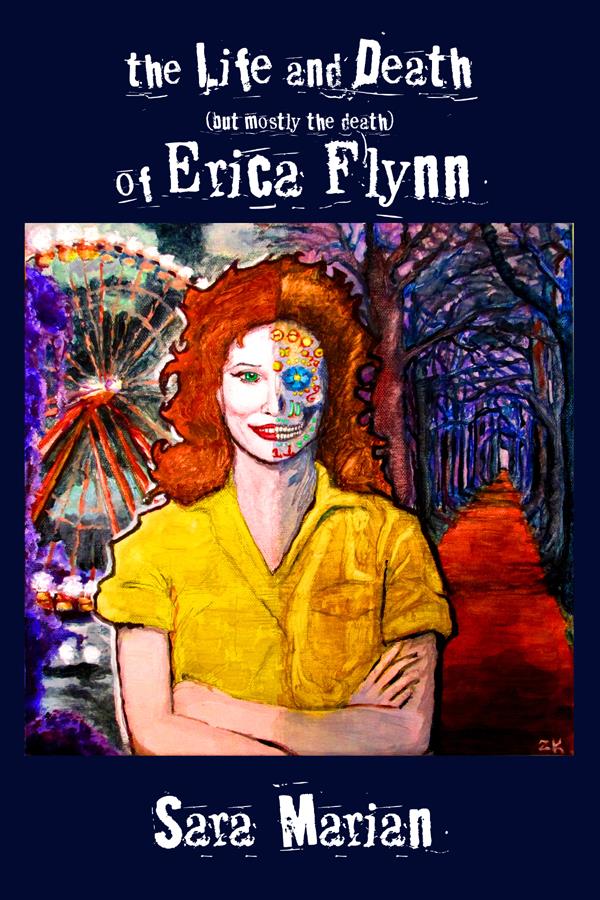
The Life and Death (but mostly the death) of Erica Flynn

erica flynn cover mokshaMy novel, The Life and Death (but mostly the death) of Erica Flynn is now available through Amazon!  Print copies are $14.99, Kindle edition only $2.99. The cover art is the work of Zakary Kendall, who also happens to be my partner in crime boyfriend.  The cover design is by T. Lee Harris of 3 Fates Press.  I am so thrilled with the way the book looks – many thanks to you both for that!

On Saturday, March 1, I will be attending Books N Brews in Nashville, Indiana, as one of the 3 Fates Press authors.  Small press books at a microbrewery?  Sounds like my idea of a good weekend!  For more details about the event, click here.  I will have copies of Erica Flynn there for sale!

Words cannot express how excited I am that this book is finally out in the world.  I’ve loved these characters for many years now, and it’s thrilling to finally share them with readers!  Thanks to all my friends, colleagues, and professors, who have spread the word, bought the book, liked the links, and given me props for this book release.  It’s a beautiful thing, y’all.  Thank you.


The Cussedness of Short Stories

I am not here today to post writing advice.  Today, I am here to post about an aspect of writing that is incredibly difficult for me.  Call it a rant, call it a cry for help…whatever.  So these calls for short stories keep coming to my attention…short stories for anthologies with absolutely awesome themes (I can blame my publisher, 3 Fates Press, for 2 out of the 3 painfully cool themes).  And short stories, for me, are like pulling teeth.  Ask me for a novel any day – I mean, it’ll take a year to write and another year to edit, but I can come up with the material – no problem!  But a short story is a different animal.

“Nonsense,” you say.  “Surely a short story is much easier than a novel!  It’s short.  A novel is long!  It’s simple.  A novel is complex!  It only needs one conflict and one climax.  A novel needs many!”  Ah.  Yes, all these things are true.  But therein lies the difficulty.  I feel claustrophobic about short stories.  I have to have enough conflict to make a story, but not enough to draw it out.  I have to develop and push the characters – but very succinctly.  I have to make the story world vivid, but I can’t put in anything that isn’t directly relevant to the forward progression of the plot.  Mind you, I can write a haiku poem like it’s nobody’s business – I can be efficient with words!  One of my personal rules for novels is that every scene has to do at least two jobs, or it gets cut.

My hope is that the motivation of having 3 awesome themes to work with, combined with the process of actually writing 3 short stories within a few months, will kick my brain into understanding how it’s done.  In the meantime, those of you who find it easy to churn out short stories should count yourselves lucky – and feel free to offer advice on plotting (and keeping a plot on task)!  Ha!

Progress for Erica

It’s definitely past time to do an update here!  Happily, I have news to post.  My novel, The Life and Death (But Mostly the Death) of Erica Flynn, has changed hands – but is now back on track to publication thanks to Three Fates Press.  I signed the contract last week, and by this time next year, the book will be released!  I’m excited to be moving forward with it, and excited to be working with my new publisher, too.  I’ll add news here as things progress, of course, and attempt to get back to updating on a regular basis, also.

School is keeping me busy this semester (what’s new?) and with NaNoWriMo coming up, I’m increasingly jealous of everyone I know who is managing to find the time to participate.  I’m writing roughly 7,500 words per week of essays, which adds up to 30,000 words in one month – can I count THAT toward NaNoWriMo???!  I want to write the draft of my Erica Flynn spinoff (same Underworld, different dead people), but NOOOOOOOOOOOOOOOOOO, I have to concentrate on schoolwork.  Blah! 

In the meantime, however, I can probably manage to use Thanksgiving Break and the first part of Winter Break to write a steampunk story for an anthology for Three Fates Press, which I’m also looking forward to.  I mean, what’s more fun than writing about a sociopathic automaton?

What I’m Working On….

I’ve started work on a new novel – a second novel set in the Underworld established in my upcoming The Life and Death (But Mostly the Death) of Erica Flynn.  It isn’t a sequel, per se, since it’s a new set of characters and is (mostly) set in a different part of the Underworld, so I guess that makes it a spinoff…?  Whatever it is, I’m having fun writing it and getting back into the rhythm of writing just about every day.  Figuring up what’s left of the summer, if I write 5,000 words per week, I can have a 60,000 word rough draft by the beginning of Fall semester.  This week, I only got in 2,000 words, but the beginning is always hard – when you’re in the habit of editing more than writing, it’s hard to switch gears and stop thinking your ideas to death.  The rough draft process, for me, requires letting go of 90 percent of my impulses to control the story…usually my subconscious seems to have a much clearer idea of what to do than the rest of my brain gives it credit for.  I can clean up any places where it got sloppy later.

Given that I’ll be out of the country for a month (and extremely busy) this summer, I’m not sure how likely I am to end up with a complete rough draft before school starts again, but I’ll give it a shot!  If I can churn out 54,000 words in 30 days (NaNoWriMo 2010), I don’t see why I can’t do this.

When I Go to Russia….

For half my life now, I’ve wanted to go to Russia.  In less than a month, I’ll be heading to St. Petersburg for a four-week program on museum studies and the history of Russian art.  The first question most people ask me when I tell them I’m learning Russian is, “Why Russian?”  I find this question incredibly irritating (I’ve never heard anybody question why any other language) but that’s a rant I don’t need to get into here and now….

Anyway, the answer is, because I love Russian literature.  It’s what got me started being interested in Russia, starting with Dostoevsky and expanding to Lermentov, Bulgakov, Chekov, Gogol, Pushkin, and Turgenev.  No, I’ve never managed to really get into Tolstoy, in case you’re wondering.  And though Dostoevsky and I disagree on some major philosophical points, he remains one of my all-time favorite authors.  His ability to make thoroughly despicable people into heartbreakingly sympathetic characters and his intense portrayal of the fragility, beauty, and horror of the human psyche at the height of his literary career is impressive in itself, but his growth and change as an author is possibly even more admirable.  In his early works, he writes like an awkward, dreamy young man (not unlike many of his early narrators).  After his arrest, mock-execution, and exile, his writing flourishes – all his early skill with writing beautifully-crafted words from the heart bursts out of his dream-state youth into full awareness of the realities around him, and his full strength as a writer, as a social commentator, as an observer of human behavior, finally came through.

As a writer, I find the intensity of his development inspiring.  I can’t say that I ever want to experience a last-minute pardon from execution or a decade’s imprisonment in Siberia, but I can say that I hope that any difficult, frightening, awful times in my own life (because, let’s face it, everybody experiences some hard times) will push my writing to new levels, open me up to new and profound possibilities, and strengthen my creativity into something with real power behind it.  A good writer is a nice thing to be, but to be a great writer takes not just ability, but growth.

The Dostoevsky Museum isn’t on my program’s list of sites, but I’ll definitely go on my own to see it, and his grave site nearby.  I’m sure I’ll have plenty to say about that visit when the time comes!

Happy Mother’s Day!

People have been asking me what it’s like to have a writer for a mom for as long as I can remember.  I always liked making up stories, but Mom has been my unfailing encourager and supporter throughout my writing life – my first editor, the first person I bounce new ideas off of.  Mom wrote my stories down when I was too young to write myself (patiently taking time out of her own writing schedule for my extremely frequent interruptions).  She typed my stories on request until I was about eight, when she taught me how to type.  She gave me my first computer so I could work on my first book when I was ten.  She took me to writer’s workshops, science fiction conventions, and weekly Southern Indiana Writers Group meetings, introduced me to other writers, editors, and publishers.  We were our own little writer’s workshop while I was growing up, and still are, in a lot of ways.  If either of us is stuck, we know the other will happily brainstorm with us over the phone.

Having an instant writing buddy in your mother is something you appreciate all the more when you’re around other writers later on, when you realize that most writers have to actively seek out other people who understand the process, the love, the frustration, the mindset that you can and will use anything as material, the sparks of inspiration, the terror of a blank page….  Writers are a little bit (or, in some cases, a lot) crazy, and it can be lonely when you’re the only one around.  I consider myself extremely lucky to have always had someone around who gets it – who has as much fun as I do brainstorming story ideas, coming up with writing exercises and story challenges, explaining imaginary alternate endings to movies that could have been good (if we had written the script)….  So the answer is, having a writer for a mom is awesome.  Thank you, Mom – for everything, but especially for your friendship and encouragement.

Confessions of a Busy Writer

There is a sneaking worry that every writer who can’t afford to be a full-time Writer gets when other life pursuits take the front seat for an extended period of time….  Am I still a writer if I’m not writing?  Every once in a while, since I started back to school, this thought creeps into my head – even now that I have a publishing contract – and not updating my blog for months at a time is one result of that.

But my answer to this doubt is, Yes, I am still a writer, because I am still building up ideas and plots, and I will still put them together and down on paper.  Also, there is a part of my brain that is now hard-wired to store away odd bits of information from every source (classes included) for the construction of storylines and weird characters.  I’ve mentioned here before that I have plans for a follow-up to The Life and Death (But Mostly the Death) of Erica Flynn.  The ideas all clicked into place for the new novel while I was in my Introduction to Eastern Religions class.  Since, like Erica Flynn, my new main character will also experience death as a major turning point rather than an end, I’m sure the realities of death that I’ve learned about in my two courses on Skeletal Forensics (and at the lab looking over actual skeletons and burial records) are going to affect the way I portray death in the new novel.

The thing is, I think it’s expected of writers (and we writers do it to ourselves) to define themselves not only primarily, but almost exclusively as Writers (or authors, if we’re lucky!)  Or maybe it’s just me – because I know that my own satisfaction with myself as a person has consistently hinged on whether or not I was working on a book.  When I wasn’t writing, I felt bad about my life and myself, and when I was writing, I felt pretty positive and self-assured.  Writing is what I enjoy most and what I feel I’m best at, where I’m most in my element (possible exception:  tromping around the woods).  But in branching out and putting my life focus on other things (study, a career, opportunities related to study and career) I’m tremendously excited about the possibilities not only for my other pursuits, but also for the possibilities this opens up for my writing!  It has to be on the back burner for the moment, coming in third on my priorities after school and survival (yes, school comes before survival on my list,) but it’s going to be so much the better for all the new experiences I’ll have to draw from.

Enough spilling my guts.  Next blog:  Weird Stuff I’ve Learned at School.  Stay tuned!