Maybe it’s because I’ve seen it so many times now, maybe it’s that I’ve never liked being told to calm down, or maybe it’s because it’s used so widely for commercial purposes, but for whatever reason, the KEEP CALM AND CARRY ON meme gets on my nerves. Apologies to those of you who love or use the meme; I’m not pointing fingers or trying to hate on anyone…It’s one of those trivial things that shouldn’t annoy me, but it does – so I’m ranting. It’s possibly the least creative meme phrase of all time, it’s not funny, it’s not thought-provoking…in short, I can’t understand WHY it’s popular. And, although calmness is a wonderful thing, the phrase “Keep calm and carry on,” outside of the WWII context from which the phrase originated, connotes a complacency that doesn’t sit well with me. You’re not saying, “Keep calm and solve problems,” or “Keep calm and think clearly,” or “Keep calm and do what you can.” Which is fine if it’s WWII and you’re just trying to bolster morale. But we’re in an unsustainable world system that’s got serious problems. We can’t sit back and carry on living in complacency while things break down. People need to be active, informed, and motivated to do more than shop and watch television. Just my humble opinion here, mind you.
Dasha’s Diary: Entry 002
Chinchilla’s Log, Entry 002
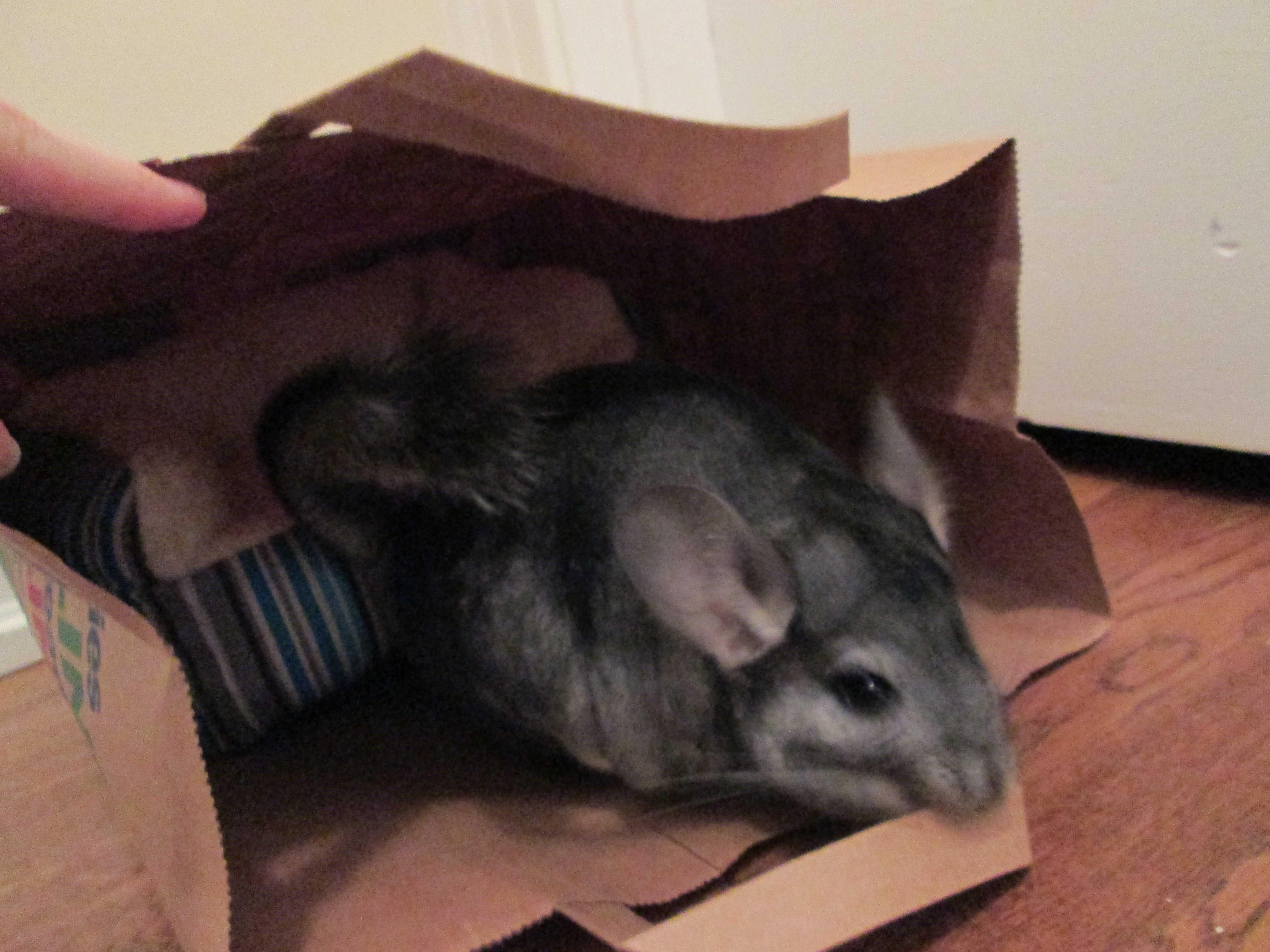
Dasha here. The humans’ behavior continues to baffle me. I have noticed some inconsistencies since my last entry. First, the humans walk around in The Great Habitat, the floor of which has no bedding at all! I know they have access to bedding, because the small human provides my home (the Lesser Habitat) with a fresh supply of it every week. I watch her do this from my runabout ball, so I know it is the small human who brings me provisions. It is bad enough that they walk around with all their weight on their hind limbs all the time, which must be a great strain and very hard on their back paws, but to do so on the bare, hard surface of the Great Habitat must make it even worse. I know their hind paws need protection from such abuse, because they wrap their lower limbs in tubes of fleece to help alleviate the problem. However, when I try to help them by sharing the bedding from my Lesser Habitat – and make no mistake, it requires effort and athleticism to get the majority of my own bedding spread as far out into the Greater Habitat as possible – the humans are unappreciative. The small one makes a kind of cooing noise by blowing air through her mouth and nose at the same time, and uses the “brume” (a large chew toy with a wooden handle attached to a bundle of dry grasses) to take away all the bedding I so generously offered. The big human makes a loud noise, STOPIT, if he sees me at my work. I don’t think they understand that I am trying to help them.
Additionally, I have noticed that the humans do not get enough exercise and that they seem lethargic much of the time that they are in the Great Habitat. They do spend a lot of my sleep-day Outside, so it is possible that they exercise while I am asleep. However, when I have been Outside with the small human, I have not seen any human-sized exercise wheels, runabout balls, or other athletic equipment, so I fear that this is not the case. I know from experience that lack of exercise can lead to an unpleasant state of mind and body, so I try to encourage them to play now and then by unexpectedly dashing from the Lesser Habitat when they open the door, leading them in a merry chase around the Greater Habitat. Strangely, they seem to appreciate this even less than when I share my bedding with them. The big human gets loud (his usual tactic) and the small human gets agitated and grabby if I don’t respond when she calls my name. It is particularly strange that it distresses them for me to demonstrate my agility, speed, and gymnastic prowess under such conditions, but overjoys the small one when I display these skills while in The Hallway (i.e., Playtime).
Still, they pet me and feed me and sometimes carry me around so I can look at things not visible from the Lesser Habitat. The big one makes music for me and the small one controls the radio, and usually plays things I like. The small human looks after my needs, and the big human sneaks me extra treats when the small one isn’t looking. Even if they are strange and tend to interrupt my meditations upon the nature of the cosmos, I enjoy their company, and they are my family, whether they accept my help or not.
The Pros of Cons
Last weekend, I attended the first annual Imaginarium Louisville – a convention for writers, readers, and cover artists. This was easily the best-organized, friendliest, and best-programmed convention I’ve attended in the last 5 years or more. And it wasn’t just the folks running the event who made it awesome. I met some intensely creative, fun, and interesting people last weekend that I look forward to seeing at next year’s Imaginarium (if not at another event in the meantime!) One of the things I’ve always appreciated about being around other writers is that 99% of all writers I’ve met are generous with advice, interested in everything, and respectful of others’ styles and ideas.
The only down side is, now I’m so fired up about writing AND I HAVE NO TIME TO DO IT!!!!! School, much as I enjoy it, and work (lucky as I am to have two part-time jobs that I love) and all things related to school and work take up pretty much all of my time…and what little I have left is used on maintaining my sanity and doing things like, you know, sleeping, eating, and taking showers on a daily basis. However, winter break will be here before I know it… If I am never NOT insanely busy (and I hate being busy, so this is fairly likely), here are the things I want to work on:
1. The second edition of The Life and Death (but mostly the death) of Erica Flynn, which will be released through Per Bastet Publications as soon as I finish proofreading it and writing the new “director’s cut” scene in the final 1/3 of the book. This will hopefully happen in early October!
2. The second book of the trilogy (yes, I said trilogy), which is partially underway.
3. A full collection of post-apocalyptic short stories, all set in the same world as “She Who Dines on Heavenly Food,” my cyber/steam punk crossover starring Penelope & Puddingfoot. And yes, I want to write a second Penelope & Puddingfoot story…I’ve already written the beginning.
4. Another book of speculative fiction short stories (which I haven’t started) based on pieces of Russian history.
Now, all I have to do is graduate…
Upcoming Event: Imaginarium Convention
Friday, September 19 – Sunday, September 21 is Imaginarium Louisville! I will be there all three days (in the vendor room with copies of Erica Flynn!) and will also be speaking on the following writing panels:
Saturday 11am: Cover Lovin’ (cover art and first impressions)
Saturday 1pm: Sword & Sorcery Vs. Fantasy (the differences between)
Sunday 9am: Lone Hero Vs. Heroic Group (which works best?)
Sunday 11am: Into the Wastelands (post-apocalyptic fiction)
Sunday 1pm: Finding the End (how to end a story)
Sunday 2pm: Unconventional Fantasy (avoiding tropes & cliches)
For a full schedule of the convention programming & events, click here:
The Pintia Field School
This June, I spent three weeks at an archaeological field school in northern Spain, working on an Iron Age necropolis called Las Ruedas. The necropolis served as a burial place for the Vaccean city of Pintia, which housed about 5,000 residents over 170 acres, and was occupied from around 400 BCE to roughly 600 CE. The necropolis contains burials from the Vaccean, Roman, and Visigothic phases of the area’s history. The Vacceans who first built the city of Pintia were a highly advanced Celt-Iberian civilization, with skilled artisans and excellent defensive structures–though the Romans did eventually conquer the city and settle in the area. The site straddles a stream, with the residential area and necropolis on one side, and the crematorium and artisans’ quarters (metal works and pottery workshops) on the other, which would have reduced the risk of fire in the residential part of the city.
The interpretive material the Pintia staff has put together for Las Ruedas Necropolis emphasizes the link between modern-day residents of the region and their own ancestry (the Vaccean people who lived here before them, whose descendants they are). Site director Dr. Carlos Sanz is especially focused on making the graves of the necropolis more personal. Each of the excavated tombs is marked with rough chronological dates, age at death and sex of the deceased (when either can be estimated), and requiem poetry (70 poems are by Aderito Pérez Calvo, a late friend of Dr. Sanz, and the rest are Celtic or Latin requiem poems). The stela (standing stones) which mark the graves have been re-placed in their original position, and a cypress tree is also planted near each excavated grave. There are larger, modern monuments with Celt-Iberian symbols, including one dedicated to the warriors who were not cremated (like the majority of Vacceans), but exposed to the vultures after death. Another is a Roman-style monument of tile, engraved and decorated in Vaccean patterns, which Dr. Sanz made himself. It has spaces where cylindrical tubes containing catalogued remains can be inserted once excavation and analysis is complete. This makes it possible to return the remains to the necropolis, while also maintaining provenience for other researchers who may analyze the remains in the future. An empty area in Las Ruedas is now used for dedications to people who have supported and helped with the project who have since died. The monuments and dedications bring to the forefront that the past and the present of the area are linked in important ways, that heritage has meaning, and that long-dead ancestors were real people with real lives. I found the care and attention to detail in the interpretive material both touching and impressive. It highlights how important the presentation of information can be in stressing the significance of a site and giving visitors a sense of connection to the people of the past.
Within walking distance of the necropolis is the tiny village of Padilla de Duero (population around 70), where the University of Valladolid’s Federico Wattenberg Center for Vaccean Studies is located. The Center, founded by Dr. Sanz, houses a small museum (which doubles as a living/dining area for students), a dormitory and kitchen, a laboratory, and a curation facility. Eva Laguna is in charge of putting together the publications for the Center, and she and Dr. Sanz cook all of the delicious Spanish meals for the students, as well. We were a small group–only five students–so we each got a lot of guidance during work hours from Dr. Sanz and Rita Pedro, the international coordinator, translator, and co-director of excavations.
On our days off, we went on excursions to see, for example, the castle at Piñafiel, the Vaccean exhibit in Palencia, and the University of Vallodalid’s rare and antique book library, as well as part of the university’s anatomical collections. We went canoeing one afternoon through a gorgeous canyon with cliffs full of birds’ nests. On our last full day, we visited an excavated Roman villa, as well as Altamira and Monte del Castillo, two caves containing 18,000-year-old paintings.
Work days were split in half: by 7:45 a.m. we were on site working, then headed back to the Center (or, more often, Angelina’s, the cafe down the street from the Center) around 1 pm. At 2:30, we had lunch, followed by siesta time (or free time, if you could stay awake), and at 5 we headed back to work. Dinner started around 9:30 p.m., but since we genuinely all liked each other, we usually stayed up late socializing, swapping music, and watching movies together instead of going to bed early.
Even with only three weeks of fieldwork, we put in 150 excavation hours, plus seminars on Vaccean culture, osteology, artifact processing and repair, archaeological drawing, and stratigraphy. While stratigraphy may not sound like the most exciting thing about fieldwork, it’s one of the most important things for an aspiring archaeologist to learn, and it’s not something I could have learned from a textbook or in a classroom. Even though I understood that stratigraphy provides the context for the materials and shows the layout of the site’s features (pits, structures, etc.), when I first started digging I had no idea what to look for in terms of changes in soil composition. After spending a few days in the field with instruction, I couldn’t believe I hadn’t been able to see feature outlines or composition changes from the start. It isn’t that stratigraphy is particularly difficult, but you do have to physically work on a site in order to get the hang of it.
We excavated two units, each of us spending some time digging and some time screening for artifacts. Most of what we found were pottery sherds and faunal remains (burial of portions of the funerary feast was common), but we also found small pieces of cremated human remains, metal objects (brooches, pieces of weapons or belts, etc.), and canicas (decorated ceramic marbles, also traditionally buried in Vaccean graves). Just when it looked like we might not uncover an actual tomb during our excavation, we came to a collection of intact vessels–including a funerary urn. After cleaning all around the area to make sure we didn’t miss any associated artifacts, we took elevation measurements and drew the tomb into the site map, photographed everything in context, and took the pottery back to the Center for processing. The interior of each vessel was scraped with a scalpel in order to take a small sample to be tested. These samples are analyzed to determine the contents of the vessels–whether they contained wine, olive oil, or ash from human remains, for example.
Our success with the tomb coincided with Padilla de Duero’s feast of San Antonio, and we were invited to join the festivities along with the whole town. With cause to celebrate over our fieldwork and only a few days before the end of the program, it was the perfect time for a big feast in great company, followed by late-night dancing and singing.
I couldn’t have asked for a better field school experience, and I’m grateful to all the people who shared that experience with me–my hard-working fellow students and the always-informative Pintia staff, the staff of ArchaeoSpain and the University of Valladolid, and the kind and hospitable people of Padilla de Duero–as well as the people who made it possible for me to go: the University of Louisville Department of Anthropology and the Etscorn International Summer Research Awards Committee.
Operation: Feeding Frenzy
Classes start soon, and with that comes the knowledge that – however much I like to cook and want to eat nutritious and delicious (and cheap) meals during the semester – feeding myself and Zak tends to fall by the wayside once school starts. So I’ve spent the last week or so arming myself (and my freezer) with ways to make it easy to chow down without resorting to packaged meals and pizza every night of the school year. Yes, I take eating seriously, and yes, the semester will be conquered by my tactical assault by means of vitamins and essential nutrients. Here’s the logistics:
1. Breakfast. The meal I hate the most. Being not a morning person, it’s like eating breakfast is an admission of failure – once I start eating, I have officially woken up, and now I have to go do stuff and behave like a civil human being around other human beings who would probably also rather be asleep. And yet, I’m hungry and will feel even worse if I don’t eat something. Usually this means I put breakfast off until I’m about to run out the door with a stomach full of nothing but coffee. And I’d like to eat both a granola bar and a tube of yogurt, but I never do (because I’m incredibly lazy in the morning). So here’s my solution:
Dried cherries + dried blueberries + vanilla yogurt covered raisins + regular raisins + sunflower seeds. Throw into a bag, shake up, then put the mix into the emptied raisin boxes. One box = breakfast…and it’s got protein, B vitamins & anti-oxidants, plus a sugar boost.
2. Lunch. Normally this consists of either Wendy’s dollar menu on campus or, if I’m at the lab, an instant macaroni bowl with queso added to it. Although queso mac and Wendy’s are definitely still options, there’s this… So about once every two weeks, I end up making a ginormous batch of something – stew, slow cooker pork roast, roast beef, whatever. And of course the two of us don’t go through all of it before we’re like, “Okay, I’ve had beef stew three days in a row – Enough already!” So I throw the whole thing in the freezer and forget it exists until I’m trying to fit groceries into the freezer and can’t. So about 1/2 the freezer is full of plastic containers that are 1/2 full of leftovers in big blocks that don’t thaw for two days. So I split up the frozen leftovers into sandwich-size ziplocks, froze them flat (so they thaw quickly) and ended up with about a month’s worth of lunches and more room in the freezer.

Chicken tomatillo soup, Blue cheese Italian chicken & veggies with rice, Chile, Beef Roast Stew, Tomato chipotle soup, and Pork stew – and that’s not even all the stuff I have in the freezer!
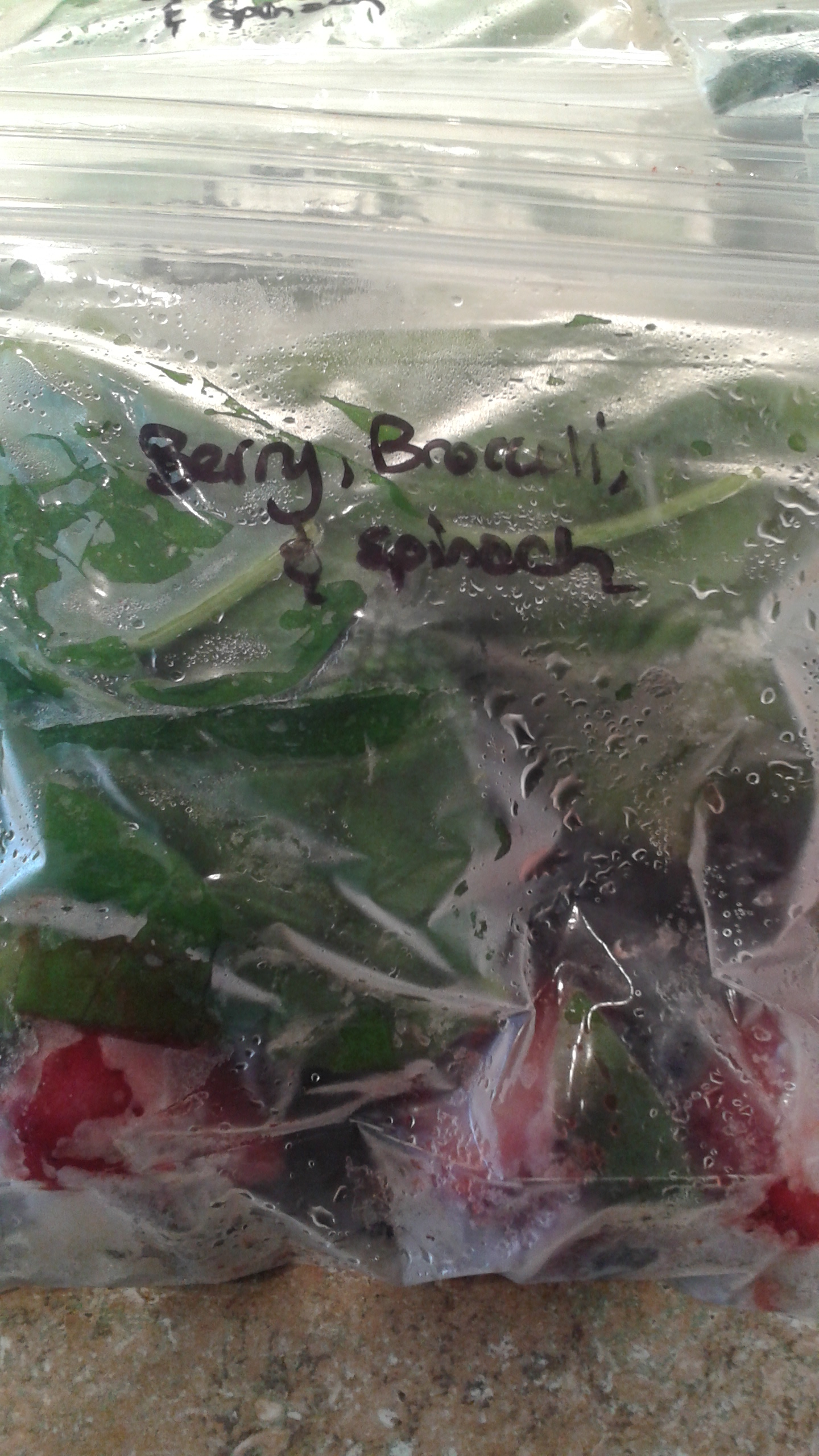
3. Smoothies. I love them so! When you don’t have time to get fresh fruits and veggies from the grocery, though, you can run out of things to put in your smoothies pretty quickly – or else you don’t use up your produce quick enough and it all goes bad, which is worse. So I got the idea (from Pinterest) of making “smoothie packs”: pick your produce combo, throw it in a sandwich bag, and freeze it. When you want a smoothie, grab a pack from the freezer, empty it into the blender, add some yogurt and applesauce (or whatever liquid) and you’re good to go. Yay! I made about 7 different “flavors” using these fruits & veggies: strawberries, blueberries, raspberries, peaches, apricots, cantaloupe, watermelon, honeydew, bananas, avocados, spinach, kale, lettuce, broccoli, cucumber, zucchini, and carrots.
4. Dinner!!! This calls for serious tactics, since dinner is my favorite meal of the day. So:
- 4a. Spent the summer finding recipes that are quick, easy, and don’t use a ton of dishes. Have become a huge fan of the one-pot wonder meals on Pinterest, where I can literally throw all the ingredients (including the noodles) into a covered pot and have dinner 1/2 and hour later. There’s chicken Alfredo, pasta primavera, veggie lo mein, creamy Buffalo penne…you name it! Then there’s savory “cupcake” recipes. Take almost anything and put it in a muffin tin lined with wonton wrappers and bake it for 20 minutes, and it’s awesome. Taco cupcakes and shepherd’s pie cupcakes are my personal favorites!
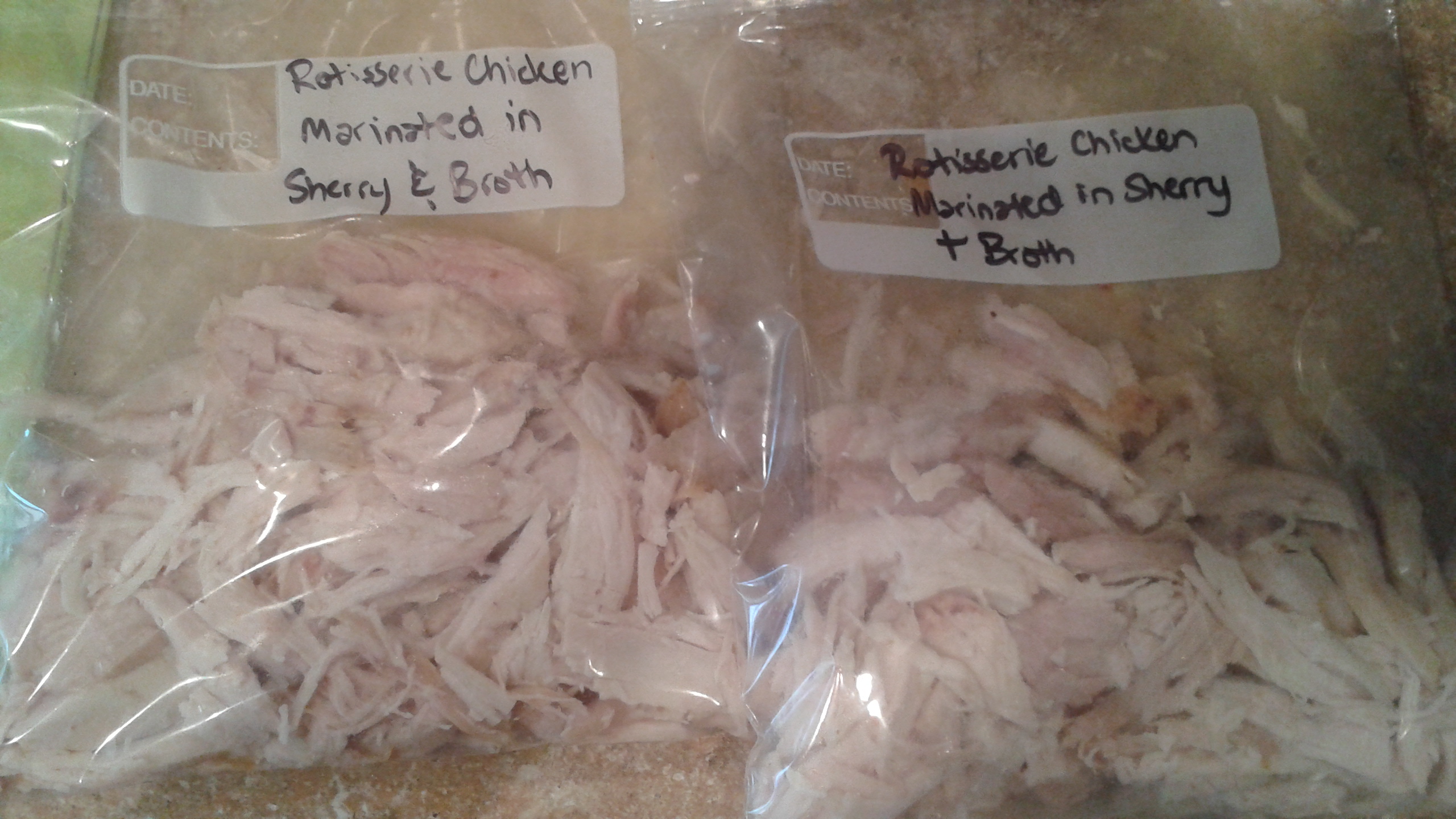
- 4b. Get a rotisserie chicken. Pull all the meat off it. Toss a little chicken broth and/or white wine in with it so it won’t be dry. Freeze it in small portions. Now when you want a some chicken on a salad, for a pasta dish, or in a soup, you don’t have to cook the chicken. Hooray!

- 4c. Ramen can become a decent meal without taking much longer than it normally takes to make it. All you have to do is add some good flavoring, crack an egg into the hot broth, and stir. Normally my “fancy ramen” includes coconut milk, also. As for the other seasoning I add to fancy ramen, well…I figured I’d just mix up a big batch instead of adding all the ingredients individually.
- 4d. Take a cue from Europe once a week! A plate of bread, good cheeses, fruit, and some form of sliced sausage (smoked sausage, hard salami, etc.) is a damn good meal, and only requires you to pick the stuff to put on the plate. And by good cheese, I’m not talking about a few slices each of Swiss and American cheese. I’m talking about the good shit you get from the deli area of the grocery. I’m talking about Manchego, aged white cheddar, goat cheese with sundried tomatoes and herbs, etc. A little sample size of a few is all you need; you don’t have to break the bank with a huge block of $15 cheese!
- 4e. When my brain is in school mode, it’s not always easy to think about what’s for dinner. So I made two lists to put on the fridge: 15 Minute Meals and 30 Minute Meals. Everything else can wait for the weekend!
10-Word Poems
I’ve been doing my best to organize my stuff (especially papers) before the fall semester begins. In going through the huge plastic tubs full of notes, documents, writing exercises, random movie ticket stubs, drawings from nephews, etc. in order to categorize everything into folders, I’ve run across a lot of things I’d forgotten about. Some of the things I’d forgotten I had, I’ve been so happy to rediscover. Letters from my family from times when we were far apart, comic books my nephew drew and mailed to me, notes from high school classes with my friends…sure have brought a smile to my face and, at times, tears to my eyes in the past few weeks.
One of the really fun things I rediscovered was a set of 10-word poems that my mom and I wrote. It’s a writer-nerd game that any number of writers can play together: Each person writes their name on a sheet of paper and passes it to however many other writers there are. When each sheet has a title from each person (except the person whose name is on it) it gets passed back to the owner. When you get your titles back, you have to write a 10-word poem for each title. Sometimes, this gets extremely silly. Sometimes, it gets unexpectedly deep! And mind you, these aren’t haiku – you don’t have to count syllables, just words, and you can break the lines up however you want.
Here are a couple of our silly results:
Gluttonous Carnivorous Extravaganza
Meat! Meat! Meat!
What joy!
People everywhere!
Title by Sara Marian, Poem by Marian Allen
Penguin
A business suit and
A cheerful disposition —
What excellent company!
Title by Marian Allen, Poem by Sara Marian
A Chinchilla’s Life – By Dasha

Toys are no substitute for hours and hours of your attention while I run around and do Olympian gymnastics, human.
Dasha’s Journal, First Entry:
I have managed to take over the small human’s laptop. This is my first opportunity to communicate with the humans in a way they might (I hope) comprehend. Humans, if you understand this entry, please take note: My playtime yesterday was woefully insufficient. Since you don’t seem to respond to my obvious behavioral communications of ignoring you, gruffing when you try to pet me, and staring pitifully out of the bars of my cage, I feel I need to make this point more clearly. No, the toys and wheel in my cage are not a consolation.
To the small human: I do not understand why you make high-pitched noises every time I bark to tell you and the big human to be quiet while I’m trying to rest. I wish I could figure out the strange noises you and the big human make, because most of the time it sounds like gibberish. The noise you address me with most often sounds like Noe, and seems to be your attempt to request that I ignore my instinct to chew on everything in sight. I try to be polite and only chew when you aren’t looking, but you still make loud noises when you look in my direction afterward. I feel that giving me a treat would be a more appropriate response.

Of course I have plenty of my own things to chew on! But if I am kind enough to make sure your things are chewed on, too, you should thank me, not scold me.
Thank you for turning off your swing jazz music long enough for me to hear some AC/DC the other day – I hope you could tell by my intense expressions of acrobatic appreciation how pleased I was, particularly once the volume was up loud enough for my liking. Bon Scott’s voice is a joy to hear, and I am sad to learn (through the boxes on your laptop, small human), that he is no more.

I’ll just mourn Bon Scott by chewing on something for a while…life does go on… *sigh*

Cage bars block the proper grooming of the scritchy-spot. For best results, give me an opportunity to escape and run around chewing on things!
To the big human: The chin-scratch, as practiced by the small human, can only be accomplished with the appropriate cage door open. Through the bars, you can’t possibly reach the scritchy-spot properly. Also, you haven’t been producing enough music with that thing that makes the sounds of absolute joy and wonder whenever you’re chewing on it…I think I have heard the small human refer to it with the noises Harm-on-a-cow, which makes no sense because there are no cows harmed in the making of that beautiful music. I like the music you’ve been playing on the Get-her, however.
The small human makes loud sounds at me if she sees me sitting on the laptop, and she may not understand what I’m doing if she finds me here. So this is Dasha, signing off.
(Sort of) Guest Post
For years now, my mom (Marian Allen) and I have been obsessing over Mikhail Bulgakov’s The Master and Margarita, and specifically over the cat Behemoth (our favorite character in the novel). My mom is also obsessed with Hello Kitty. So yesterday, I spontaneously decided to draw Hello Behemoth for Mom. Today, she posted the picture on her blog for Caturday, and I’m counting that as a guest post because it means I don’t have to write a real post. Ha! (By the way, dear Readers, something about all this does relate to the sequel….)
yWriter 5, and Why I Might Become an Outliner
Thorough outlining is not generally my thing. My attitude is usually more like, “Well, this is a cool storyline, and I know where I want it to end up. Here’s a couple cool things that could happen in the middle. Let’s connect the dots!!!” But. It’s very hard to pace an entire novel with the by-the-seat-of-your-pants method. It can be done (though probably not in a first draft, unless you’re the Mozart of novelists), if you’re willing to tear the entire thing apart and put it back together a bunch of times. But. I’d like to make it a little easier on myself for the second Underworld novel, especially since there will be multiple points of view involved. It was hard enough keeping things on track with just Erica, let alone the crazy-ass hooligans who’ll show up in Book II!
So I’m using yWriter 5, a free program by Spacejock Software for novel outlining. What, good ol’ pen and paper isn’t good enough anymore? you ask. Index cards were good enough when your mother started HER second novel, you sneer. But, dear reader, it was my mother who told me about the yWriter Project, so…dear reader, kindly shut yer gob. (J/K, you know I love y’all!) Point being, yWriter is pretty sweet. It seemed a little complex and overly-detailed to me when I first started playing around with it, but now that I’m really trying to get this novel laid out, I’m seeing the usefulness of all of the program’s tools and reports.
Example 1: You can rate each scene’s relevance to the main plot, as well as its humor and tension level. Then you can look at a chart of all your scenes and see how the flow of your plot builds, the build-up and release of tension, and the ebb and flow of humor throughout the course of the novel. If there’s no forward movement of the plot in the entire middle section of the book, you’ll see it visually right away. If you have no tension in the first section of the book, you’ll see it in the chart. And if the first half of the book is funny and the second half is pure tension and anguish, you’ll know you need to fix that before you plunge into full-on writing. Example 2: Characters, locations, & items. Especially for a series, this is great. You add characters to the file and then add them to whatever scenes they appear in (and which scenes are from their viewpoint). Since your character descriptions, biographies, goals, alternate names, etc. (you can even load a photo or drawing into their file) are clickable from the outline, it’s easy to keep everyone’s stories straight (no pun intended) and everyone’s hair/eye color in mind (don’t you hate when you mix them up?) You can also put in specific locations and items, each in their own separate files within your project – again, helping you keep your details straight, or reminding you of settings that your characters might need to return to, avoid, etc. Nifty! You can also pull up a report to see how many scenes each character appears in, which is a great early-warning signal that somebody might be trying to hijack the book to be All About Them when it isn’t.
Of course, nothing ever goes as outlined – I know once I get started, a billion things will shift around and run off in different directions and go at a different pace than I wanted…but that’s the fun part! I like writing best when my stories surprise me with being more awesome than I could ever have planned on purpose!